
Welcome back to the world of Rainfall! Today we’re going to be doing something a little more fun. We’ll be talking a bit about what went in to the creation of the Old World Magic wielding class: The Enchanter.
So, since I haven’t talked much about classes yet, what is an Enchanter? Simply put, they are the caster class that uses Old World Magic. Now that raises another question: What is Old World Magic? That one is a bit trickier.
Old World Magic is one of the two forms of magic that exist in Rainfall. In general, Old World Magic falls back on the old adage of “any sufficiently advanced technology is indistinguishable from magic” or something to that effect. Put simply, Old World Magic is the technology that was lost when the world was destroyed.
Old World Magic works mostly off of “Devices.” These essentially are whatever piece of technology that either still works or someone has repaired enough so that it will work. For example, a toaster is an example of an Old World Magic Device. A Device needs two things to work: Maintenance and Power.
These Devices are so old that they’re falling apart. You thought planned obsolescence was bad now, Imagine trying to keep a modern device working after the apocalypse. So, Enchanters need to ensure they make the necessary repairs and preventative maintenance to keep them operational. Nearly every marvel of modern technology requires some form of electricity to power it. Devices in the World After are no different. Enchanters need to power up their devices and expend the power they put in them to make their effects happen.
These two concepts translate nicely into some D&D concepts that people should be familiar with for casters. When an Enchanter prepares their spells for the day, they’re doing maintenance to make sure their Devices will still work. Their spell slots represent how much electricity they have generated and stored up in power cells. When an Enchanter casts a spell, they are powering up a Device they have repaired and using the electricity stored in their power cell to make the effect happen. Obviously more impactful spells require more power to operate and thus higher level spell slots.
I think you can see where I’m going with all this. Enchanters are the replacement for Wizards in Rainfall. It doesn’t make sense for there to be Wizards slinging spells around from a spell book in the post apocalyptic Earth of Rainfall. I think that Wizard archetype is important though and I wanted Old World Magic to be a thing, so the Enchanter was born as a merger of the two.
For a bit of a teaser, here is the draft class table for the Enchanter.
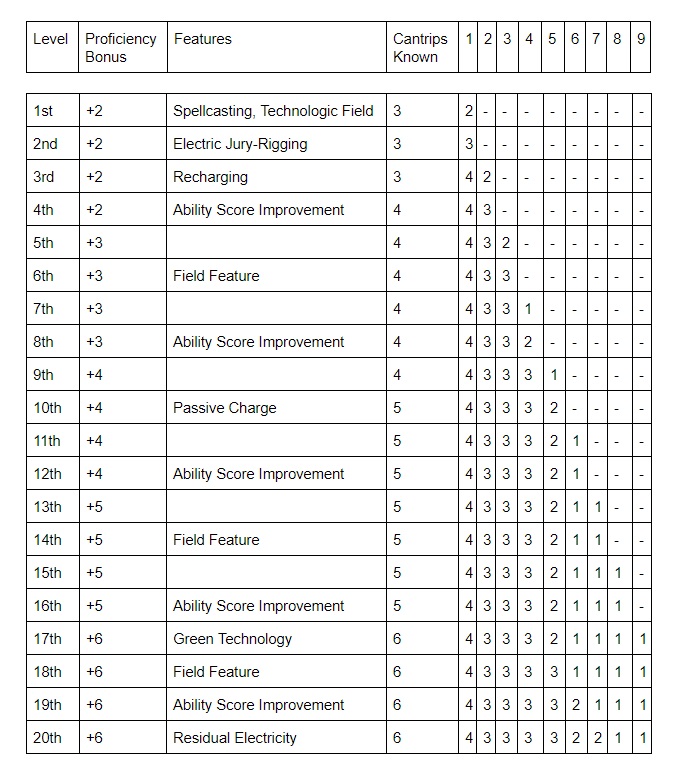
As a bit of behind the scenes, in my first ideas for this class, the Enchanter was called the “Mage”. I leaned a bit heavier into the fantastical and magical aspects of the concept. The first class build of the Enchanter followed that as well. Originally, the Mage was just the Wizard by a different name. All the first build of the Mage did was change the flavor text in the Wizard’s description of preparing and casting spells to match the concept of Old World Magic and then left everything else the same.
I found that to be very boring though. Why waste this key piece of world building on a reskin of a Wizard? So I went back to the drawing board. I started from the question: what does an Enchanter do, exactly? So I fleshed out the Old World Magic casting system to match what I described above. No longer was it sort of mystical. Now it was scientific. Spells require certain amounts of electricity and that electricity was represented by the level of a spell slot.
So then I took the base Wizard class and built around that concept. Some abilities stayed where appropriate, but others were added or dropped or changed. Soon I had to grapple with the problem of subclasses. For the Wizard, those are based around schools of magic. Should the Enchanter be the same? I tried some initial builds with some slightly altered versions of spell schools for the Enchanter but they just didn’t fit. They seemed so at odds with what the fantasy of being an Enchanter is.
Now, the Enchanter has Technological Fields. In my current draft, the Enchanter has 8 Fields. I’ll wrap this all up by giving a brief rundown of those.
Communication focuses on devices that can allow someone to communicate, obviously. They have things like radios, cameras, video, and projectors. They can power up multiple devices that are linked, like their own payphone and one on the same network, and by max level they can even access the internet. For the most part, Communication plays similarly to an Illusion school Wizard.
Gunslingers focus on, what else, using guns. They are the equivalent of War Magic Wizards and focus a lot on combat. They get access to guns as weapons and extra attacks. By max level, they can get a more specialized gun like a silenced pistol or shotgun.
Pilots are all about using vehicles of all kinds. These Enchanters can not only power up and fuel vehicles from the World Before, but they also get special bonuses for themselves and their passengers while in them. They get boosts to AC and gain cover while in them and can share certain spell effects with their passengers. By max level, everyone in their vehicle gains many benefits for driving along and become stronger while inside the vehicle. These Enchanters take the place of Abjuration Wizards due to the amount of defensive abilities they can put up.
Electricians are the bread and butter of Enchanters. If you’re looking for a pure Enchanter experience, this is it. Electricians can modify their spells in many ways such as delayed activations or setting trap triggers for them. By max level, they can supercharge their spell slots, expending all of their slots of one level to boost it several levels higher. These Enchanters share a lot with Evocation Wizards.
Robotics is all about the minions. These Enchanters gain more powerful summons than others, first in the form of bonuses to their familiars, then to other summons, and finally to animated objects. At max level, Robotics Enchanters gain access to an AI of their very own. This acts a lot like a commune spell where the AI can answer questions for you but also can help you with skill checks. These Enchanters obviously overlap a lot with Conjuration Wizards, but their effects can also apply to Raise Dead, giving them some overlap with Necromancy as well.
Hackers are in a slightly weird position. They deal mostly with computers and security systems. That can be a bit of a niche skill. To supplement that, they can also use their computer skills to improve their own skill checks and those of others, allowing this Enchanter to be a skill monkey. By max level, they can get a laptop of their own and can create programs to interact with other systems, allowing them to do whatever the hardware is capable of, not just what they were programmed to do. These Enchanters have little overlap with Wizards, but I wanted computer skills to feature with the Enchanter, so here they are.
Neuroscience gives the Enchanter the ability to alter their own or other creature’s perceptions. They can charm others or predict the future as well as read thoughts and turn off senses. This Field is most closely related to other Wizard schools since it leans heavily on the spells it casts and not its features. It is a combination of both the Divination and Enchantment Wizards.
Finally, Terraforming allows Enchanters to alter the land around them. They can alter the material of objects, create new material, or manipulate what is already there. By max level, they can turn anything in anything else with the use of True Polymorph more often than the average Wizard. These Enchanters have close ties to Transmutation Wizards.
So that’s all for Enchanters, the masters of Old World Magic. Next time, we’re going to go the opposite direction and talk about the other form of magic and its caster: The Warlock.
 City of Rainfall